What we shared and what we learned at the UNITAR Global Sustainability Forum
The superyacht industry is not used to telling its story outside its own circle. Most of the conversations that shape how our sector approaches sustainability, the taskforces, the measurement frameworks, the regenerative investment models happen within the industry, for the industry.
That’s by design, and it works. But it also means that the wider world, policymakers, sustainability professionals, and cross-sector voices rarely hear what we are actually doing. Or why.
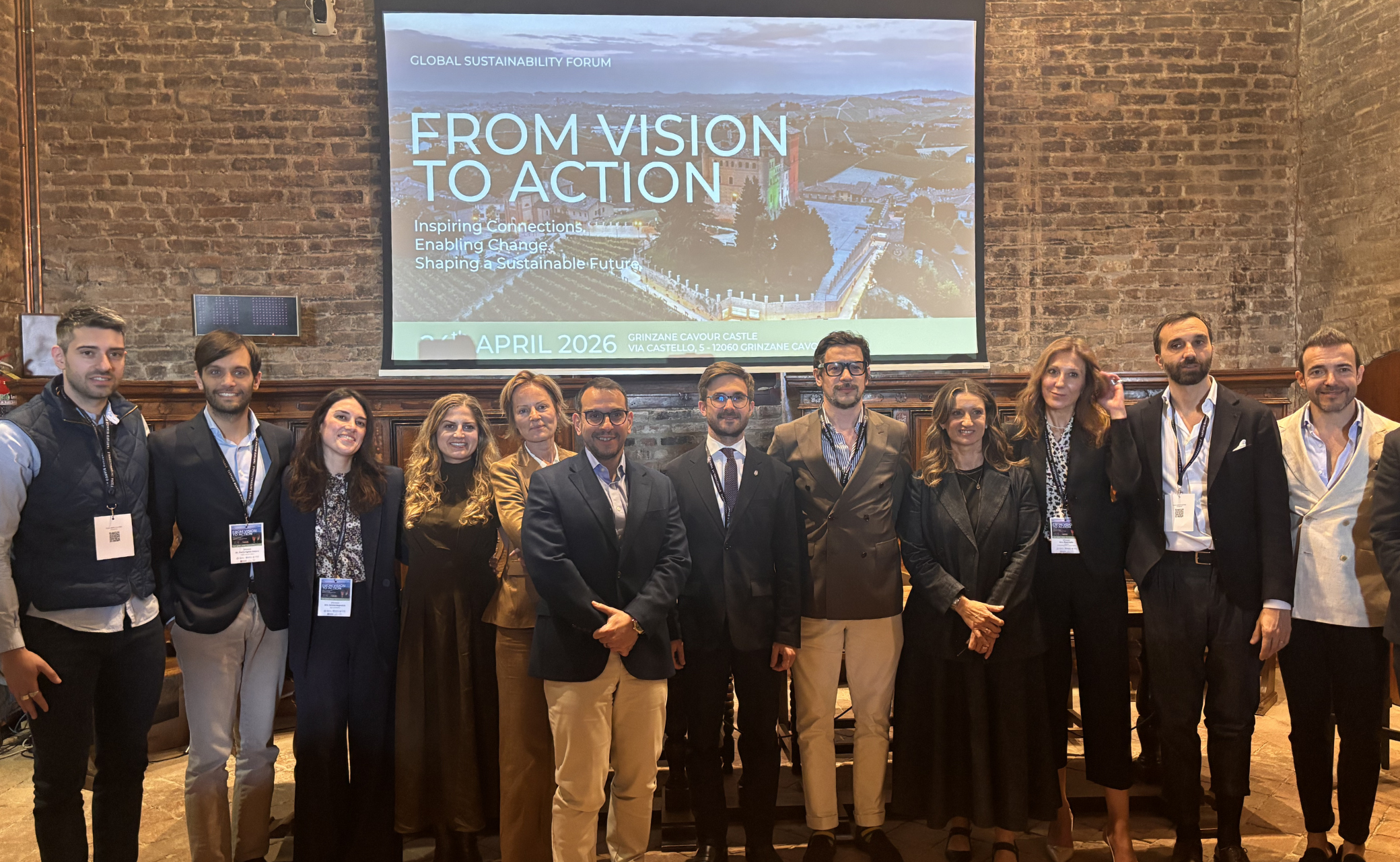
The UNITAR Global Sustainability Forum at Grinzane Cavour Castle in Piedmont was an opportunity to change that. It brought together leaders and thinkers from across industries, geographies, and disciplines under the umbrella of a shared challenge: how do we build sustainability into the fabric of how we operate, not as an add-on, but as the starting point?
We were there to make the case for the superyacht sector. And the conversation we walked into was one of the most energising, and clarifying we’ve had in a long time.
Why we were there, and what we came to say
Water Revolution Foundation exists to help the superyacht industry become more environmentally friendly and more resilient. That means building the tools, the data infrastructure, and the shared frameworks that allow an industry of independent operators, builders, and owners to move in the same direction without waiting for regulation to force their hand.
The Global Sustainability Forum gave us the platform to articulate that work in a room that wasn’t already familiar with it. And the core of what we shared was this: most industries face the same structural challenge when it comes to sustainability, there is no shortage of targets, but there is a significant shortage of tools to actually deliver on them.
Ocean Assist, our regenerative investment framework, funds the restoration of marine ecosystems, seagrass, biodiversity, and critical habitats, with measurable, independently verified ecological outcomes. In the Venice Lagoon, for example, we support seagrass restoration within a defined area, improving biodiversity, stabilising sediments, and enhancing carbon capture. Through the UN Important Marine Mammal Areas (IMMA) programme, we also contribute to the protection of critical marine mammal habitats in waters where superyachts are most active.
These are the kind of interventions that leave the system in a better state than before and they can be structured, transparent, and scalable, so that companies across the sector can participate in a credible, meaningful way.
We also spoke about the dynamics that make any of this work in practice. Credibility matters more than claims people respond to independently verified data, not assertions. Ease matters because the barrier to sustainability is rarely intent; it’s friction. Ownership matters because solutions built with the industry get adopted by the industry. And value matters because the moment sustainability shows up in commercial decision-making, it stops being a side initiative and becomes part of the business.
What the forum gave us in return
The forum covered sustainability across its full scope environmental, social, local, regional, and international. Speakers were candid about where the broader movement has struggled, and where the real opportunities lie. Several threads struck us as particularly relevant to bring back to our own industry.
One of the most honest was the acknowledgement that we are currently in what one speaker called a “sustainability winter” a period where political appetite has cooled and some of the commitments made in the warmer years are showing their roots to be shallow. But the framing was not defeatist. If anything, the argument ran the other way: periods of lower scrutiny are periods of opportunity for those who want to lead rather than follow. The organisations that use this time to build real systems not just reporting frameworks, but genuine structural change will be the ones who set the direction when attention returns.
“It is not whether sustainability can be made compatible with business. The question is whether business can be made compatible with sustainability.” Ioannis Ioannou — speaker, UNITAR Global Sustainability Forum
The distinction matters. Too many organisations still treat sustainability as something to be made to fit a constraint to manage, rather than a lens through which the business itself is designed. The forum made clear that this is not just philosophically flawed; it is strategically risky. Companies that confuse being less bad with being prepared for the future are, as one speaker put it, only borrowing against it.
A second theme was the link between environmental and social sustainability and the risk of separating them. A fair supply chain is not optional; it is foundational. Finally, the forum challenged a familiar pattern: collecting data without acting on it. Reporting has advanced across many industries, including ours. But insight that doesn’t inform decisions is just noise. The real value lies in using data to drive action and that is something we intend to carry forward.
Key takeaways for our industry
- A slowdown in sustainability momentum is an opportunity to lead, not wait.
- Environmental, social, and financial priorities must work together not in sequence.
- Measurement only matters if it informs action.
- Framing matters: aligning business with sustainability is the real challenge.
There is something clarifying about taking your work outside its usual context. The UNITAR forum reminded us that the challenges our industry faces are not unique — and neither are the paths forward. What is distinctive about the superyacht sector is the opportunity it has: a smaller, higher-value industry with the means, the motivation, and increasingly the tools to do this properly.
The conversations we had at The Global Sustainability Forum reinforced what we already believe: the real opportunity is in what happens before regulation, not after it. And that window is open now.