by Water Revolution Foundation | 3 Feb 2026 | News
ISO/TS 23099 approved: A Major Milestone for Sustainability in the Large Yacht Sector
The International Organization for Standardization (ISO) has formally approved ISO/TS 23099, a two-year international standardisation project inspired by and elaborating on the outcomes of the ground breaking Yacht Environmental Transparency Index (YETI) Joint Industry Project, spearheaded by Water Revolution Foundation. The Technical Specification establishes, for the first time, a harmonised and science-based method to assess and compare the environmental performance of large yachts.
National Standardization Bodies within ISO, including those representing major yacht-building nations Italy, The Netherlands, Germany, Turkey, Poland, the United Kingdom, and the United States, have approved ISO/TS 23099, a new Technical Specification developed under ISO Technical Committee 8 (TC8), Subcommittee 12 (SC12) for large yachts. This approval marks a significant step forward in providing the superyacht sector with a science-based method and internationally recognized reference to assess and compare environmental performance of yachts.
ISO/TS 23099 is the first project delivered by the ISO TC8 SC12 Working Group 6 (WG6) on Large Yachts Sustainability & Environment, underscoring the growing commitment of the industry to measurable, transparent, and credible environmental responsibility.
WG6 convenor Robert van Tol states: “ISO is the way to unite cross-industry experts and pro-actively work together on own standards where international legislative guidance is absent or proves impractical to implement.” He adds, “There is now a yacht-specific method and official reference to be applied for assessing the fleet.”
The Technical Specification is the culmination of a five-year joint industry effort, bringing together leading yacht builders, naval architects, technical experts, research institutes and classification societies. Its objective is to establish a robust and practical methodology to assess and compare the operational environmental performance of yachts over 30 metres in length.
Hanna Dąbrowska, Technical Director at Water Revolution Foundation, explains: “the method benchmarks yachts through a fixed median values operational profile that was statistically found of 10% cruising, 34% at anchor and 56% in port, which is fundamentally different from that of commercial shipping. The result is indicated through a score against a reference line of central tendency of scores in different gross tonnage (volume) categories.”
By defining a common framework and consistent assessment approach, ISO/TS 23099 enables objective comparison, supports informed decision-making for both new build projects and refit scenarios, providing a foundation for continuous improvement across the sector. Importantly, it offers a shared language for environmental performance, helping to align industry efforts and avoid fragmented or proprietary approaches.
Awwal Idris, Environmental Expert at Water Revolution Foundation, adds: “Next to CO2 equivalent to translate the environmental impact over several indicators into a single score, the TS introduces the more sophisticated EcoPoints, a common factor in life cycle assessment, made up of a combination of various underlying environmental factors, including CO2 and NOx. This outcome enables users to fully understand the impact, but also to work out different scenarios to improve, both for new build and refit projects.”
The approval of ISO/TS 23099 represents a critical milestone in the evolution of environmental standards for large yachts and reflects the industry’s collective determination to move from aspiration to measurable action.
Lorenzo Pollicardo, Technical & Environmental Director at Superyacht Builders Association (SYBAss), states: “This approved ISO reference confirms shipyards proactive commitment toward the decarbonization objective and enables further work and validation testing through application and use to make it more robust and widely adopted, setting an instrument useful to also support future yachts tailored emission provisions in the international regulatory framework. This and other future projects under WG6, provide shipyards and other industry stakeholders with practical ways toward more environmentally driven yacht design, construction, and operation.”
by Water Revolution Foundation | 1 Jan 2026 | News
We are proud to announce the appointment of Leah Werner as the new Executive Director of Water Revolution Foundation, effective 1 January 2026.
Leah succeeds Robert van Tol, who has served as Executive Director since the Foundation’s inception and will now assume the position of Executive Director of the Superyacht Builders Association (SYBAss).
Trained as a biological oceanographer, Leah joins us with 13+ years of leadership experience at the intersection of environmental science, policy, and implementation, with a career centred on translating scientific concepts for non-technical audiences, decision-makers, and industry stakeholders. Her work has spanned government and industry-facing roles, marked by collaboration and effective execution. She brings a strong track record of building cross-sector collaboration and helping industry coalesce around practical, sustainable solutions, directly aligned with our mission to drive environmental progress in the yachting sector. In this new chapter, the Ocean Assist programme remains a core pillar of our work; Leah’s extensive background will be instrumental in identifying new opportunities to scale the initiative, ensuring it continues to grow in impact and reach.
In her previous role, Leah led strategy and stakeholder engagement for major remediation and water infrastructure programmes across the U.S. and internationally. She represented federal environmental authorities in high-profile negotiations and public forums, helping to build trust among governments, industry, and communities. Her leadership in advancing climate resilience, ecosystem restoration, and long-term stewardship across complex maritime and water-linked environments aligns closely with Water Revolution Foundation’s mission to drive environmental progress in the yachting sector.
“My focus will be on building strong partnerships, aligning industry for adoption and implementation of everything the foundation has brought forward over the last 7 years. We enter a critical new phase embedding actionable standards and tools to truly move forward as a collective. Together, we can drive measurable progress that supports both the industry’s future and the health of our ocean.” – Leah Werner
Honouring a Founding Leader
We extend our deepest gratitude to Robert van Tol for his exceptional leadership and unwavering commitment to building Water Revolution Foundation into the driving force for environmental progress it is today. From shaping its mission and programmes to cultivating a trusted global network, Robert has been instrumental in establishing the Foundation as a catalyst for science-based change within the superyacht community.
As he transitions to his new role as Executive Director of SYBAss, we are grateful for his enduring contributions and continued presence within the wider industry.
“I would like to thank the partners for their support and trust over the last 7 years. The Foundation and its programmes are here to stay. I would like to welcome Leah to the Foundation, I am excited to see her take the Foundation to the next level and bring her expertise into this industry.” – Robert van Tol
Leadership Continuity
With Leah’s appointment, Water Revolution Foundation continues its commitment to strong governance, strategic leadership, and long-term impact. Her experience, vision, and deep understanding of environmental systems will be essential as we move forward with our three-year plan and further strengthen the Foundation’s role as a catalyst for environmental transformation within the yachting sector.
We are delighted to welcome Leah to the Foundation and look forward to the innovation, collaboration, and renewed momentum she will bring.
Welcome to the Revolution!
by Awwal Idris | 12 Dec 2025 | Insights
The EU has now finalised the Omnibus I political agreement on sustainability reporting and due diligence. This package revises the Corporate Sustainability Reporting Directive (CSRD) and the Corporate Sustainability Due Diligence Directive (CSDDD). The stated goal is to simplify the rules and reduce the burden on companies.
According to the European Parliament press release of 8 December 2025, the scope of both directives has been significantly narrowed. Under the revised CSRD, only companies with more than 1,000 employees and net turnover above €450 million are required to report. The same €450 million threshold applies to non-EU companies operating in the EU. Due diligence obligations under the CSDDD are limited even further, applying only to large corporations with more than 5,000 employees and €1.5 billion in turnover.
The agreement also simplifies how companies report. The focus shifts away from long narrative disclosures toward core quantitative information. Under CSRD, reporting is built around the European Sustainability Reporting Standards (ESRS). These come in three layers:
- Cross-cutting standards
These apply to everyone in scope. They cover general disclosures, strategy, governance, and basic metrics. - Topical standards
These cover themes like climate, pollution, water, circular economy (E5), workforce, etc. Companies report on them if they are material (significant enough to affect the company’s business, decisions, or performance) to their business. - Sector-specific standards
These is meant to add extra, detailed requirements for specific industries, like shipping, construction, energy, or manufacturing.
Originally, the plan was that sector-specific ESRS would become mandatory once they were developed. That would have meant extra metrics and disclosures on top of the general and topical standards, tailored to each sector.
However, sector-specific reporting becomes voluntary, and companies can use a central digital portal with templates and guidance. Some earlier requirements, such as mandatory climate transition plans under the CSDDD, have been removed. Enforcement and penalties remain at national level, with fines capped at 3 percent of global turnover.
The glass half full — despite the rollback
At first glance, the Omnibus deal is not reassuring. It reduces the number of companies required to report and removes obligations that were meant to drive accountability and long-term change. For many observers, this is a clear step back from the ambition that originally sat behind the CSRD and CSDDD.
Acknowledging that, the question is not whether deregulation is good. It isn’t. The question is what still holds, and what becomes even more important in a weaker regulatory environment.
On circular economy reporting, one reality remains unchanged. The largest companies still drive most material extraction, material flows, waste generation and product volumes. Even under the narrowed scope, reporting by these actors still captures where the majority of environmental pressure sits. That does not excuse the loss of coverage across the wider economy, but it does mean that material data from those still in scope remains highly relevant.
At the same time, the refocusing of the European Sustainability Reporting Standards, especially ESRS E5 on circular economy, places more weight on measurable performance. Less narrative, fewer generic statements, and more emphasis on concrete data such as material inputs, outputs, waste streams and key resources. This is not a win of deregulation, but a reminder that data quality matters more than volume, particularly when political ambition weakens.
In other words, the scope has shrunk, and that is a loss. But the basic logic of meaningful reporting — tracking real material flows and impacts — has not disappeared. If anything, it becomes more important when fewer companies are forced to report.
For the yachting sector, this distinction matters. Many companies will now fall outside the formal CSRD thresholds. That should not be interpreted as permission to pause or disengage. In a sector that is highly material-intensive and dependent on complex supply chains, the absence of regulatory pressure increases the risk of blind spots rather than reducing it.
Voluntary reporting therefore becomes more, not less, important. It remains one of the few ways to understand material use and waste, demonstrate credible circular economy performance, and stay aligned with owners, financiers and insurers who increasingly expect quantified, decision-useful data. Where regulation steps back, market expectations and industry responsibility must step forward.
Read our article on what this means for the yachting sector and how to move forward.
by Water Revolution Foundation | 10 Dec 2025 | Reports
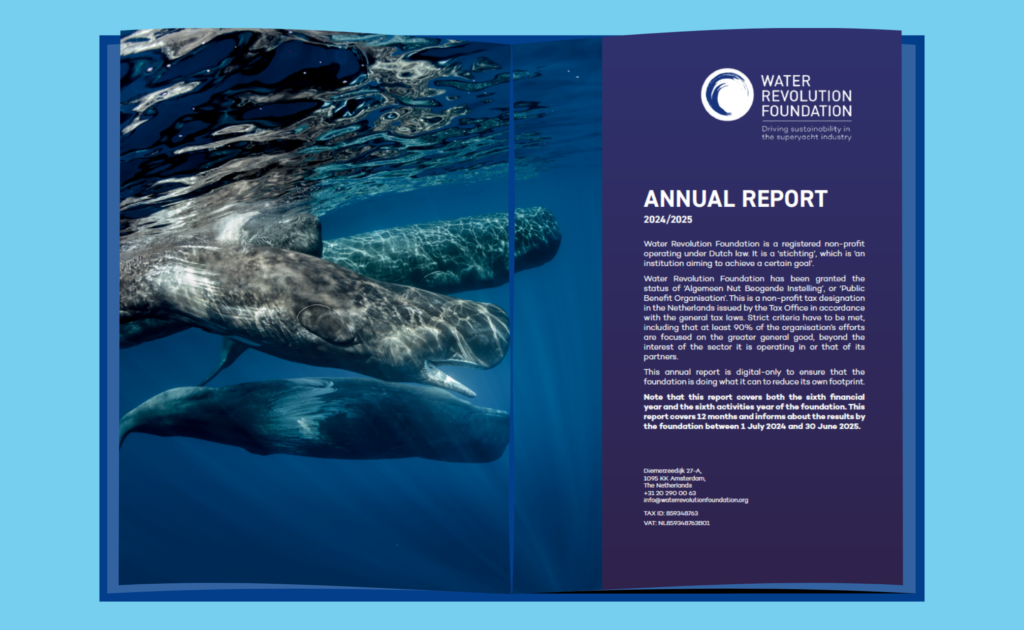
As we move into another pivotal year for the foundation, we are pleased to share our 2024/2025 Annual Report, a comprehensive reflection on the progress, partnerships, and practical action that continue to drive our mission forward.
This year’s report offers an in-depth look at the momentum built across our programmes and collaborations. It captures the foundations laid through key milestones, from the launch of Roadmap 2050 to an audience of more than 60 CEOs, to the establishment of Ocean Assist and the continued progression of YETI as the industry standard. Alongside these highlights, the report provides a clear overview of our activities, key events, and the strategic work that underpins our long-term impact.
What’s next
Looking ahead, we remain focused on building on this strong foundation. The year to come will see us deepen industry engagement, advance existing programmes, and continue to develop practical tools and frameworks that support the sector’s transition. With collaboration at the core of our approach, we are committed to turning shared ambition into measurable progress.
Read our Annual Report 2024/2025
by Water Revolution Foundation | 27 Nov 2025 | News
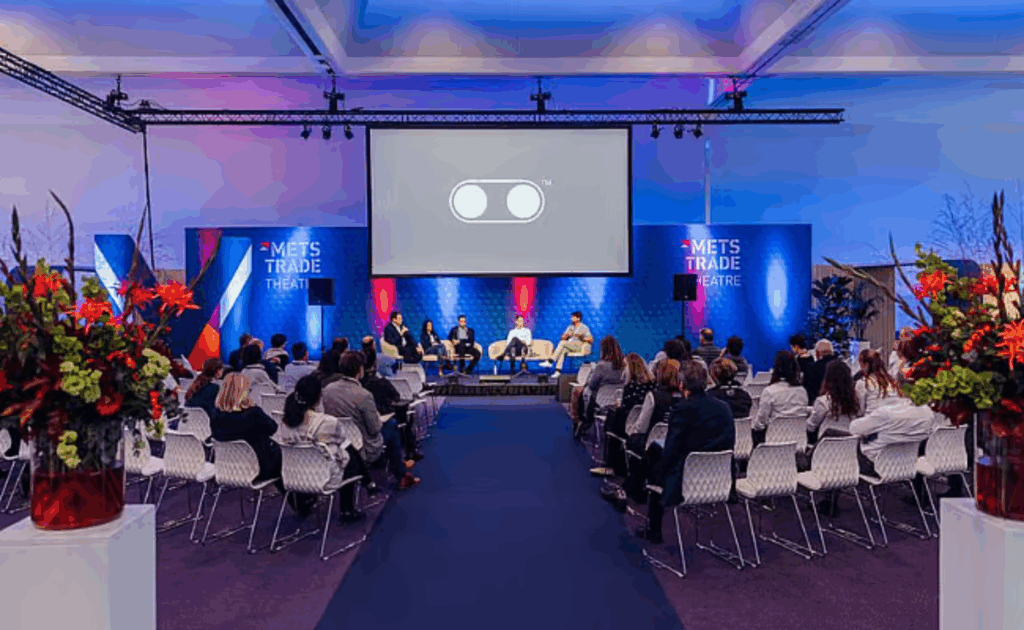
Water Revolution Foundation spent last week at the Superyacht Forum and Metstrade for a full programme of meetings, presentations and collaborative sessions. Our team contributed across multiple stages, advancing conversations on environmental responsibility and practical pathways for a more sustainable superyacht sector. Below is a wrap-up of our sessions.
NXT-GEN Anti-Fouling Session
Our Environmental Specialist, Awwal Idris joined the panel for the NXT-GEN Anti-fouling session which brought together coating manufacturers, shipyards and insurers to explore the rapidly evolving landscape of fouling control. The discussion highlighted the need to balance hull performance, regulatory changes and environmental protection, with a growing emphasis on reducing toxic releases and preventing invasive species transfer. Speakers compared differing approaches – from traditional biocides to silicone foul-release technologies – while emphasising ongoing misconceptions around operational requirements for newer systems. The panel strongly supported a sector-wide shift from “antifouling” to the broader and more accurate term “fouling control,” and underlined the increasing role of Life Cycle Assessment in material innovation, though better integration of real-world operational performance into these assessments remains essential.
HVO: Breaking Barriers to Adoption
Our Technical Director, Hanna Dąbrowska moderated the HVO session, a deeply practical session that clarified the regulatory, operational and technical realities of adopting HVO as a drop-in fuel for the yacht fleet. Certification frameworks, including EU schemes and emerging IMO guidance, were outlined to demonstrate that integrity mechanisms already exist to manage fraud risks within the renewable fuel supply chain. The panel noted that HVO is compatible with most modern engines, offers cleaner combustion and enhanced engine longevity, and maintains excellent long-term storage stability. While availability varies regionally and cost remains slightly above MGO, most barriers are rooted in misconceptions – particularly confusion between HVO and FAME biodiesel. The key takeaway is that HVO represents the only immediate and scalable decarbonisation tool for the existing fleet (however it is still a temporary solution according to the IMO), with adoption limited more by perception and education than by technology.
The Ocean Assist Programme
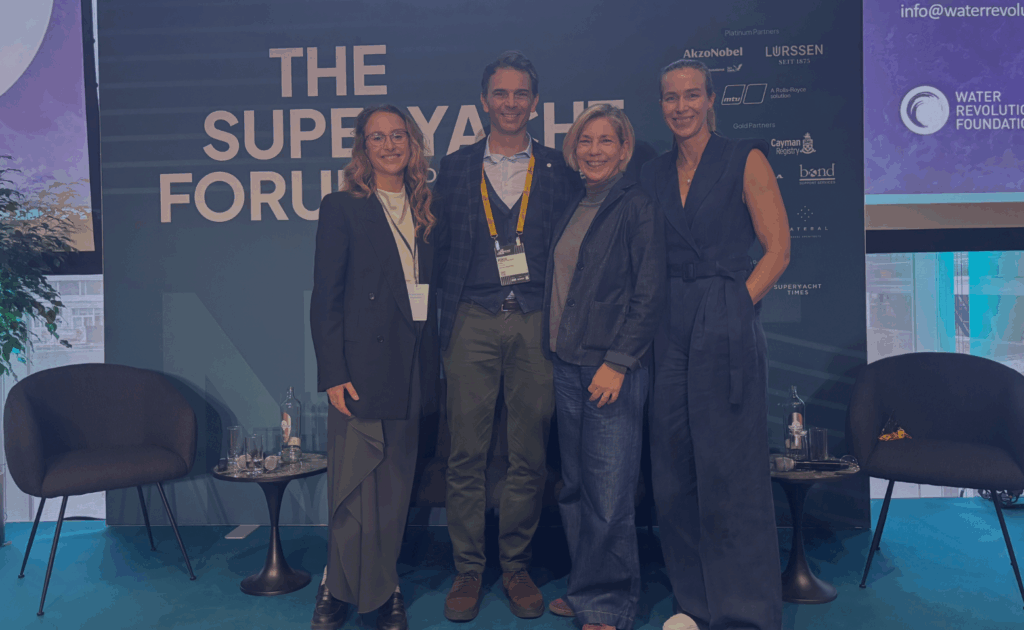
Our Initiator and Vice Chair, Dr. Vienna Eleuteri was joined on stage by Georgina Menheneott from Burgess, Fiorenzo Spadoni from RINA and Francesca Webster from Superyacht Times to discuss our new programme Ocean Assist. This session introduced Ocean Assist as a scientifically verified, regenerative investment pathway designed specifically for the maritime sector. It explained how Ocean Assist Units combine carbon removal, biodiversity regeneration, water-quality improvements and social benefits within one transparent and independently validated methodology. Case studies demonstrated operational uptake, including Burgess’ integration of these units into travel, events and fleet management, while RINA outlined the ISO 14064-3 verification process that underpins credibility and safeguards against greenwashing. With global environmental reporting expectations rising and regions like the Red Sea already embedding regenerative metrics into marine tourism frameworks, the session highlighted Ocean Assist as a forward-leaning, reputation-enhancing approach for the yachting community.
Hub of Verified Solutions Matchmaking Session
This dynamic speed-dating format connected verified solutions from our Hub of Verified Solutions with an expanded group of potential buyers, creating an energetic environment for discovery, knowledge exchange and commercial traction. The session saw strong engagement and meaningful introductions, reinforcing the Hub’s role as the central platform for proven sustainable technologies in yachting and demonstrating growing industry appetite for verified, ready-to-implement solutions.
If you would like to learn more about our Hub of Verified Solutions or submit a solution for verification, visit: https://waterrevolutionfoundation.org/programmes/hub-of-verified-solutions/
WRF IMO Zero-Framework – What Is NXT
With the decision at IMO to delay the Net Zero Framework by one year, our voluntary industry Roadmap 2050, launched last June, was the perfect topic for a session discussing what yachting can do pro-actively rather than sit back and wait for regulations. Our Executive Director Robert van Tol called this Roadmap yachting’s compass to navigate unchartered waters together. With the quantified targets in 5-year increments for the four life cycle stages of a yacht: Design, Build, Operation and Refit, all yachting stakeholders are connected and have a role to play. While investments in new technologies continue, the infrastructure and local policies would need to be updated in order for clients to go for it and avoid chicken-egg situations.
The Superyacht Coating Conference
Our Environmental Specialist, Awwal Idris, joined the panel at this year’s Superyacht Coating Conference, which returned at a pivotal time for the sector. The session explored the accelerating regulatory shift around antifouling coatings, driven by concerns over biocides that harm marine life, accumulate in sediments and affect sensitive coastal zones. With the IMO AFS Convention, the EU Biocidal Products Regulation and local restrictions on copper and co-biocides already in force – and more substances under review – the trend is clearly moving toward stricter controls and increased interest in non-biocidal alternatives.
The panel underscored the need for a solid Business-as-Usual (BAU) baseline to understand today’s typical environmental impact and to ensure new systems can be meaningfully compared against it. Life Cycle Assessment was highlighted as a practical tool for this process, enabling manufacturers to test scenarios early in formulation, adjust materials, reduce toxicity and refine performance before products reach market. The overarching message: next-generation fouling-control solutions must pair high technical performance with demonstrably lower environmental cost, supported by transparent evidence and clear comparison to BAU.
Yacht 2030
Our PhD student, Ludovico Ruggiero from Politecnico di Milano presented the Yacht 2030 project, a structured, life-cycle-based approach to supporting more environmentally friendly yacht design. The session introduced a practical framework built around three phases: measuring environmental hotspots through Life Cycle Assessment, applying targeted optimisation strategies, and benchmarking designs against both previous configurations and the wider market.
The research presented demonstrated how small but well-informed design decisions – such as selecting aluminium with high recycled content, reducing structural mass through advanced engineering, or integrating remanufactured components – can generate meaningful upstream impact reductions. Early case-study results showed that applying only a handful of targeted guidelines delivered a 10% improvement in the cradle-to-shipyard phase, underscoring the value of embedding Life Cycle Thinking at the concept stage.